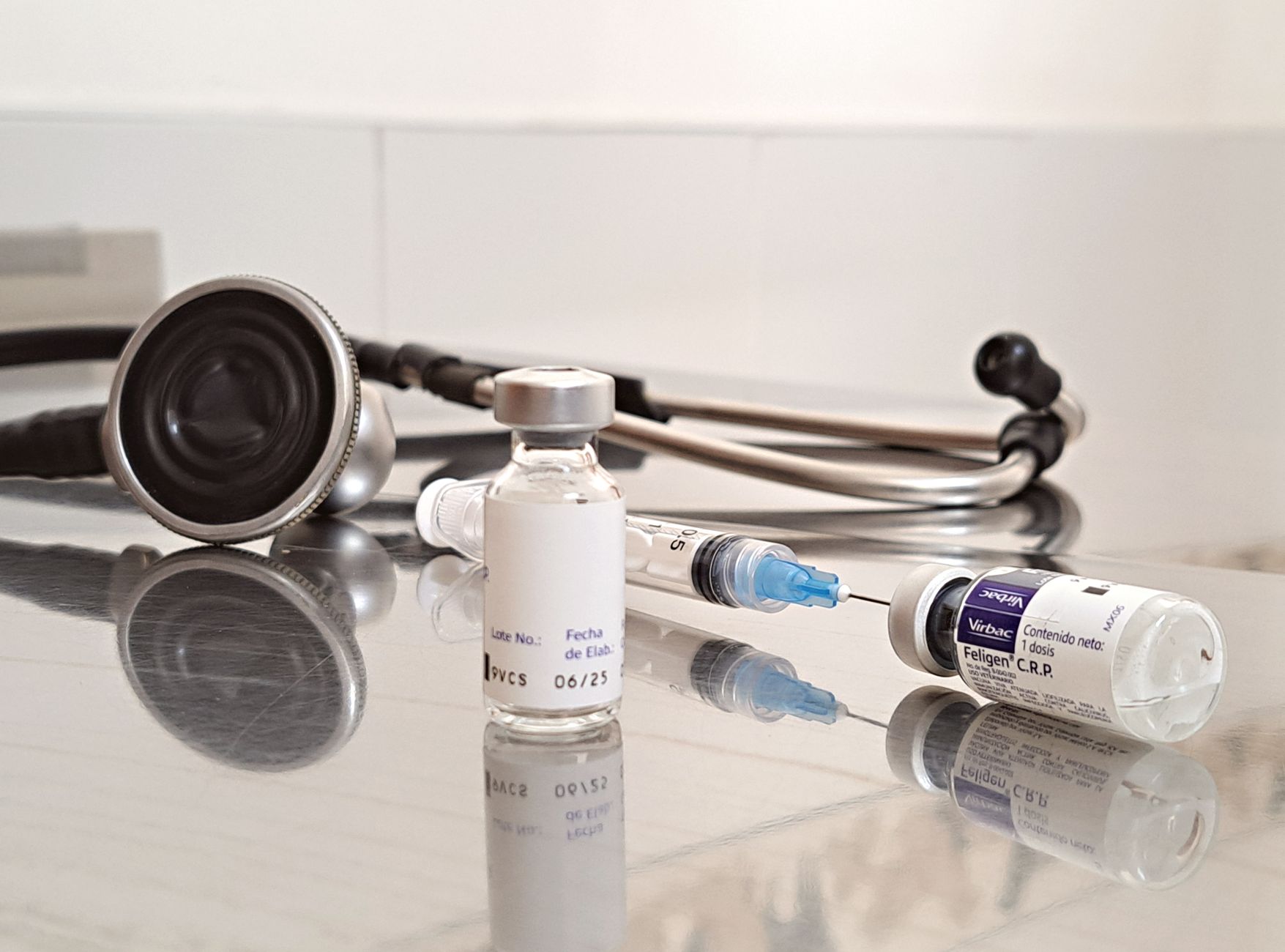
To reconstitute retatrutide means to add bacteriostatic water to a sealed vial of dry powder until that powder is fully dissolved. The order of the work is always the same: clean the stoppers, decide the water volume, draw that volume into a syringe, push it slowly down the inside wall of the glass, then swirl the vial until the liquid is clear.
Mixing does not change the quantity of retatrutide in the vial. A 10 mg vial holds 10 mg of powder before the water and 10 mg dissolved after it. What the water decides is the concentration, the amount of retatrutide per milliliter of liquid, and the concentration is the number a syringe calculation needs. Every number in this article is an arithmetic example, not advice about an amount.
What reconstitution is, in plain terms
Retatrutide is supplied as a freeze dried powder. Inside the vial it looks like a small white cake, a thin disc, or a scatter of loose flakes at the bottom of the glass. Freeze drying removed the water, so the powder has to be returned to liquid form before anything can be measured in a syringe. That single operation is the whole of reconstitution.
The liquid used for it is bacteriostatic water, often shortened to bac water. It is water for injection sold with a preservative added. Plain sterile water and saline are different products, so the type of water is part of the handling and not a detail to improvise. Retatrutide is an investigational molecule studied in clinical trials.
What to have on the table first
Set everything out before the first stopper is pierced. Stopping halfway through to hunt for a syringe is how a half mixed vial gets left open on a table.
- The retatrutide vial, still sealed.
- A vial of bacteriostatic water.
- Alcohol wipes, at least two, one per stopper.
- One syringe for the water. A 3 mL syringe with a longer needle is far easier to read in milliliters than an insulin syringe is.
- U-100 insulin syringes for measuring later. The 1 mL size holds 100 units, the 0.5 mL size holds 50 units, the 0.3 mL size holds 30 units. Smaller syringes have finer marks.
- A sharps container for the used needle.
- A pen and a label, or a strip of tape, to write the result on the glass.
- A clean flat surface, good light, and clean dry hands.
Choose the water volume before anything is opened, because that one choice fixes every syringe mark that follows. The retatrutide dosage calculator shows the concentration and the matching units for a given vial size and water volume, so 1 mL, 2 mL and 3 mL can be compared on screen while the vial is still sealed.
How to add the bacteriostatic water, step by step
- Let a cold vial stand. If the glass is cold to the touch, leave it on the table until it is not. Cold powder is slower to go into solution and harder to judge.
- Clean hands and surface. Wash and dry your hands. Wipe the work surface and let it dry.
- Open the caps. Flip the small plastic disc off the center of each vial. The metal ring stays in place. Only the rubber circle in the middle is ever pierced.
- Wipe both stoppers. One alcohol wipe for the water vial, one for the retatrutide vial. Let each stopper air dry instead of blowing on it or wiping it with a cloth.
- Draw the water. Pierce the center of the water stopper, turn that vial upside down, and pull the plunger to the chosen mark. Hold the syringe upright, tap the barrel so bubbles rise to the top, and push gently until the liquid sits exactly on the mark.
- Aim at the glass, not the powder. Push the needle through the center of the retatrutide stopper, then tilt it so the tip rests against the inside wall of the vial, above the powder.
- Push slowly. Let the water run down the glass wall in a thin stream, over roughly ten to twenty seconds, so it reaches the powder as a rising pool rather than a jet. Many vials hold a slight vacuum and will pull the water in by themselves. Let that happen at its own pace rather than forcing the plunger.
- Withdraw and discard. Take the needle out of the stopper and put the whole syringe straight into the sharps container.
- Swirl, do not shake. Hold the vial by the cap and roll it gently between two fingers, or tilt it in slow circles on the table. Shaking whips air into the liquid and leaves foam, and foam makes a syringe hard to read. Swirling is enough.
- Wait for clear. Most of the powder usually disappears within a minute or two. If flakes remain, set the vial down, leave it still for a few minutes, then swirl again. A finished vial looks clear and free of visible particles.
- Label the vial. Write the vial size in mg, the water volume in mL, and the concentration in mg/mL. A labeled vial cannot be mistaken for one that was mixed differently.
Two things not to do. Do not keep piercing the same spot on the stopper when another spot is available. And do not top a mixed vial up with extra water unless the whole calculation is redone, because the moment the total volume changes, the concentration written on the label is no longer true.
Reading the result as a concentration
The arithmetic is one division. Concentration (mg/mL) = mg in the vial / mL of water added.
A 10 mg vial with 2 mL of water gives 10 / 2 = 5 mg/mL. The same vial with 1 mL gives 10 mg/mL. With 3 mL it gives 3.33 mg/mL. Three different concentrations, and the same 10 mg of retatrutide in all three.
| Vial size | + 1 mL water | + 2 mL water | + 3 mL water |
|---|---|---|---|
| 5 mg | 5 mg/mL | 2.5 mg/mL | 1.67 mg/mL |
| 10 mg | 10 mg/mL | 5 mg/mL | 3.33 mg/mL |
| 20 mg | 20 mg/mL | 10 mg/mL | 6.67 mg/mL |
| 30 mg | 30 mg/mL | 15 mg/mL | 10 mg/mL |
Three cells in that table read 10 mg/mL: 10 mg with 1 mL, 20 mg with 2 mL, and 30 mg with 3 mL. Vial size and water volume reach the syringe only through the ratio between them.
Why the water volume still matters
Less water makes a stronger liquid, so any given amount sits on a smaller number of units and the mark is finer to read. More water makes a weaker liquid, so the same amount spreads across more units and the mark is easier to see, at the cost of using more liquid each time. The calculator flags both ends of that range: it warns when a volume works out above 100 units, which will not fit in a 1 mL syringe, and when it works out below 2 units, which is too small a mark to trust by eye.
From the mixed vial to syringe units
Once the concentration is known, two lines finish the job:
- Volume (mL) = amount (mg) / concentration (mg/mL)
- Units = volume (mL) x 100
The second line holds because a U-100 insulin syringe holds 100 units in 1 mL. So 1 unit is 0.01 mL and 10 units is 0.1 mL. Units on that barrel are a measure of volume. They are not international units (IU) of a substance.
Worked examples on a 10 mg vial, as arithmetic only:
- 10 mg + 1 mL = 10 mg/mL. 2 mg = 0.20 mL = 20 units.
- 10 mg + 2 mL = 5 mg/mL. 2 mg = 0.40 mL = 40 units, 1 mg = 20 units, 4 mg = 80 units.
- 10 mg + 3 mL = 3.33 mg/mL. 2 mg = 0.60 mL = 60 units.
The same method on other sizes: 20 mg + 2 mL = 10 mg/mL, where 2 mg is 20 units and 4 mg is 40 units. 30 mg + 3 mL = 10 mg/mL, where 4 mg is 40 units. 5 mg + 1 mL = 5 mg/mL, where 1 mg is 20 units.
One more division answers the question people ask next. Amounts per vial = mg in the vial / amount (mg), rounded down, because a leftover fraction is not a full amount. A 10 mg vial divided into 2 mg portions gives 5 of them, whatever volume of water was used, since the water never added or removed any retatrutide.
Entering the three numbers you now have, vial size in mg, water volume in mL, and an amount in mg, into the calculator on the home page returns the concentration, the volume in mL, and the units rounded to one decimal place, with a warning if the amount asked for is larger than the vial. The formulas and the rounding rules behind it are written out on the methodology page.
This article is educational. It explains the handling of a vial and the arithmetic of a concentration, and it is not medical advice. A licensed health professional is the right person to consult for any health decision.