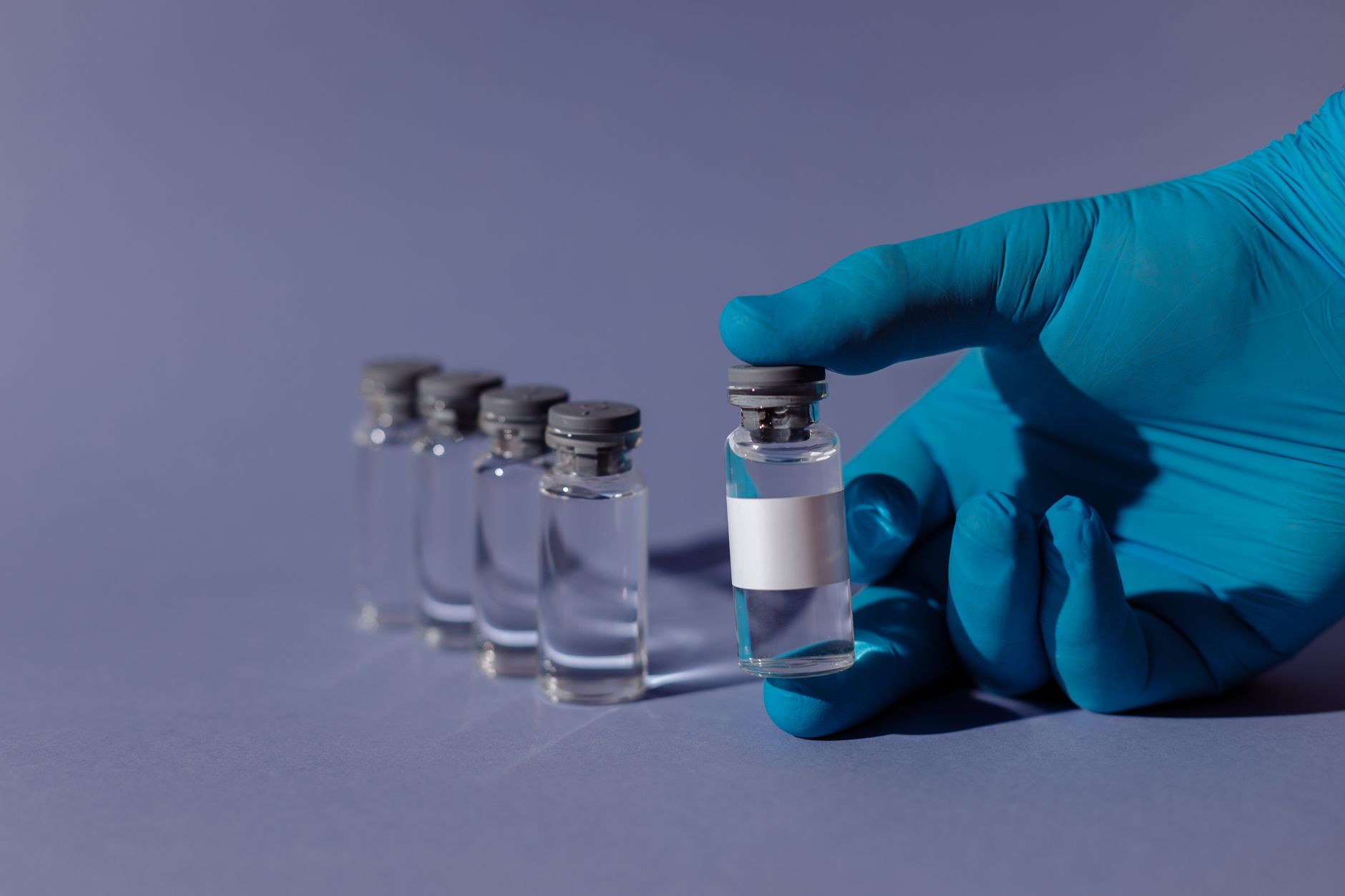
A 10 mg retatrutide vial can be reconstituted with 1 mL, 2 mL or 3 mL of bacteriostatic water, and none of those volumes is more correct than the others. The water changes the concentration and the mark you read on the syringe, not the quantity of retatrutide sitting in the vial. This page puts the three common volumes side by side for a 10 mg vial, shows the syringe units that follow from each one, and explains the trade-off between a liquid that is easy to read and a liquid that keeps a large amount inside a single syringe.
Why there is no single correct volume
Bacteriostatic water, often shortened to bac water, is sterile water that contains a small amount of a preservative. Reconstitution is the step where a liquid is added to a vial of dry powder so that the contents can be measured as a volume instead of a weight. The powder itself is a fixed quantity: a 10 mg vial holds 10 mg of retatrutide whether 1 mL or 3 mL of water goes in.
What changes is the concentration, which is the amount of retatrutide per milliliter of liquid. A smaller volume of water gives a stronger liquid, so a given amount occupies fewer syringe marks. A larger volume gives a weaker liquid, so the same amount spreads across more marks. Both describe the same vial. The arithmetic just moves the decimal point. This is why a question like 'how much bac water for retatrutide' has no single answer: the volume is a choice about readability, not a property of the vial.
The arithmetic behind bac water for retatrutide
Three formulas cover every number on this page.
- Concentration (mg/mL) = mg in the vial / mL of water added.
- Volume (mL) = amount (mg) / concentration (mg/mL).
- Units on a syringe = volume (mL) x 100.
That last step works because a U-100 insulin syringe holds 100 units in 1 mL. One unit is 0.01 mL, and 10 units is 0.1 mL. Those units are a volume. They are not international units (IU) of a substance, and they are not milligrams. Common U-100 sizes are 1 mL (100 units), 0.5 mL (50 units) and 0.3 mL (30 units), and the smaller barrels carry finer marks.
One more conversion is worth keeping in mind: 1 mg = 1,000 mcg. Some labels and some calculators work in micrograms, so 0.5 mg and 500 mcg are the same quantity written two ways.
A separate figure does not depend on the water at all. Amounts per vial = mg in the vial / amount (mg), rounded down. A 10 mg vial yields the same count of 2 mg portions whether it is mixed with 1 mL or with 3 mL.
What 1 mL, 2 mL and 3 mL give for a 10 mg vial
The table below runs the three formulas for a retatrutide 10 mg vial. The amounts of 1 mg, 2 mg and 4 mg are arithmetic examples chosen because they are round numbers, and nothing here suggests that any of them is an appropriate amount for anyone.
| Bac water added | Concentration | 1 mg | 2 mg | 4 mg |
|---|---|---|---|---|
| 1 mL | 10 mg/mL | 0.10 mL = 10 units | 0.20 mL = 20 units | 0.40 mL = 40 units |
| 2 mL | 5 mg/mL | 0.20 mL = 20 units | 0.40 mL = 40 units | 0.80 mL = 80 units |
| 3 mL | 3.33 mg/mL | 0.30 mL = 30 units | 0.60 mL = 60 units | 1.20 mL = 120 units |
Read one row at a time. With 2 mL of water the vial sits at 5 mg/mL, because 10 divided by 2 is 5. A 2 mg example is then 2 divided by 5, which is 0.40 mL, and 0.40 multiplied by 100 is 40 units. The same vial mixed with 1 mL sits at 10 mg/mL, and the same 2 mg example becomes 0.20 mL, or 20 units. The quantity in the syringe is identical. Only the volume carrying it has changed.
The trade-off between more water and less water
Less water keeps everything inside one small syringe. At 10 mg/mL, every example in the table fits a 0.3 mL (30 unit) barrel except the 4 mg row, and a 0.5 mL barrel covers that one. The cost is resolution. A 1 mg example lands on 10 units, so a misread of one or two marks is a large fraction of the intended volume. Small volumes also leave less room for error when a reader is squinting at a barrel in poor light.
More water does the opposite. At 3.33 mg/mL, a 1 mg example reaches 30 units and a 2 mg example reaches 60 units, so the same quantity is spread over three times as many marks and is easier to read with confidence. The cost appears at the bottom of the table: a 4 mg example works out to 1.20 mL, which is 120 units and therefore more than a full 1 mL syringe. A volume above 100 units cannot be drawn in one go.
Two practical limits sit around this choice. The first is the glass itself: a small vial has to physically hold the water you plan to add, so check its capacity before committing to 3 mL. The second is the useful range of an insulin syringe. Very small volumes, under about 2 units, are hard to read at all, and anything over 100 units no longer fits one barrel. The retatrutide dosage calculator on the home page flags both of those cases, along with an amount larger than the vial, and it rounds units to one decimal place.
Bac water for a 12 mg vial
The 12 mg vial is searched almost as often as the 10 mg one, and it behaves the same way. Only the starting number changes.
| Bac water added | Concentration | 1 mg | 2 mg | 4 mg |
|---|---|---|---|---|
| 1 mL | 12 mg/mL | 0.08 mL = 8.3 units | 0.17 mL = 16.7 units | 0.33 mL = 33.3 units |
| 2 mL | 6 mg/mL | 0.17 mL = 16.7 units | 0.33 mL = 33.3 units | 0.67 mL = 66.7 units |
| 3 mL | 4 mg/mL | 0.25 mL = 25 units | 0.50 mL = 50 units | 1.00 mL = 100 units |
Notice that 3 mL is the tidy option for a 12 mg vial, because 12 divided by 3 is exactly 4 mg/mL. At that concentration every whole milligram lands on a multiple of 25 units, which is about as easy as syringe reading gets. With 1 mL or 2 mL of water the same vial produces repeating decimals such as 16.7 units, which are perfectly valid numbers but harder to match against a printed mark.
By the amounts per vial formula, a 12 mg vial divides into 6 portions of 2 mg or 3 portions of 4 mg, rounded down, and that count holds for any of the three water volumes.
Checking the numbers for your own vial
Every figure above can be reproduced with a pocket calculator in three keystrokes, and it is worth doing once so the pattern becomes familiar. Divide the milligrams in the vial by the milliliters of water to get the concentration, divide your example amount by that concentration to get a volume in milliliters, then multiply by 100 to read it as syringe units. If a result looks surprising, redo it before trusting it.
For the exact rounding rules and the formulas written out, see the methodology page. For the handling sequence around the vial itself, there is a separate article on how to reconstitute retatrutide. A calculation that looks wrong can be reported through the contact page.
This article is educational and covers arithmetic and vial handling only. It is not medical advice, and it does not say what anyone should take. A licensed health professional is the right person to involve in a health decision. Retatrutide is an investigational molecule studied in clinical trials.